When you are planning to buy a used car in India, It can be an exciting yet tricky process.
Whether you’re looking for a budget-friendly first car or upgrading to a better model, online car marketplaces have made it easier than ever to browse options right from your home.
Platforms like CarDekho, Spinny, OLX Autos, Cars24, and CarTrade offer thousands of listings with detailed photos, verified sellers, and transparent pricing.
However, not every used car listed online tells the full story.
A shiny photo and an attractive price might hide a vehicle’s accident history, odometer tampering, or mechanical issues.
That’s why it is very important to know how to check a second-hand car before buying online.
In this detailed guide, I have summarized my decades of experience. Here, we’ll cover 25 expert tips that will help you inspect.
After that, you will gain enough confidence to buy a pre-owned car online in India.
Check a Second-Hand Car Before Buying in India
1. Start with a Reliable Marketplace
Whenever you are thinking about buying a car, you should always go with verified platforms like CarDekho, Cars24, or manufacturer-backed certified outlets like Maruti Suzuki True Value and Hyundai H Promise.
These platforms follow inspection protocols and provide verified vehicle histories. Avoid random classified ads or social media listings unless the seller can prove authenticity.
Also, this platform offers a 7 days moneyback guarantee unlike the local vendors. So if you have purchased a vehicle and later you are finding a glitch on it. You will always have an option to return it without any hassle.
2. Verify Seller’s Identity
Whenever you are going to buy a car, First of all, you should confirm whether the seller is a dealer, individual, or company.
If they are an individual or local dealer, you need to for valid ID proof and ownership documents. Genuine sellers are transparent; shady ones often avoid sharing personal details or rush you for payment.
- Ask for individual id cards like- id cards . If they are a dealer, you should ask them about their registration number or Gst details. Verify this detail first through the government portal.
- Check their presence online first and read their reviews on the internet. Through this you will get an idea about whether they are offering, what they are saying or not.
- Do not make any payment online before meeting them personally. Also, avoid those people, who say they need a token amount before meeting. These kinds of scams are spreading a lot in the Delhi NCR. people took the token amount & flew away.
3. Check the Car’s Registration Certificate (RC)
Once you verify that the owner or dealer is genuine, you should proceed for next step. That is to verify the car’s RC and other documents like- Insurance etc.
- Make sure that the owner’s name matches the seller.
- The engine and chassis numbers are correctly listed. You should physically check it on the car.
- The car’s registration state aligns with where it’s being sold.
- There’s no “DUPLICATE RC” mark, which could mean lost or replaced papers.
Once you will get the RC from the seller, you can go to the https://parivahan.gov.in/ and verify the details. If you find anything suspicious, do not proceed with buying.
4. Use the Vehicle History Report
After verifying the RC, it’s time to check the vehicle history. Many portals and agencies provide a vehicle history report by checking the VIN (Vehicle Identification Number). If you want to check it by yourself, you can take the help from Droom or cars24 portal.
Now some of you might be confused about what you should check in the history. Well, here is the detailed list, that you must check.
- How many people have previously owned this car? Is it a 1st owner car or 2nd owner car.
- Have this car ever met with any kind of serious accident or damage.
- How many times have owners claimed for insurance. This gives a great idea about whether it is a damaged car or fresh one.
- Let’s check for Hypothecation (loan) status, make sure that there is no loan amount pending on the car. If there is a loan on a car. Ask the seller to clear that before buying the car.
- Last but most important, make sure that the car doesn’t have blacklisting or theft records.
5. Match the Odometer Reading with Service Records
Often this has been seen, when someone sells their car, they often temper their odo meter. So that, they can show that it is a less driven car and get the maximum value of it. But you can easily challenge them by asking about servicebook.
Once you get the service history records from an authorized service center, you can compare the odo meter reading.
If you find a sudden drop or mismatch, it indicates odometer fraud. In that case, you should be very careful while purchasing the car.
6. Evaluate the Car’s Age and Depreciation
We all know that a car is a depreciating asset, so if you are buying a used car, make sure that you are paying the right price for it.
Often, people try to sell their car at a higher price if it is in good condition.
But you need to understand that a car gets depreciation from its age. So make sure that you are not paying a high price for a second hand car.
Here I have explained the depreciation value of a car by its age.
- 1-3 years old: 15–30% depreciation
- 3–5 years old: 35–50% depreciation
- 6–10 years old: 55–70% depreciation
Cross-check the model’s market price on websites like ZigWheels or CarDekho to see if the seller’s asking price is fair.
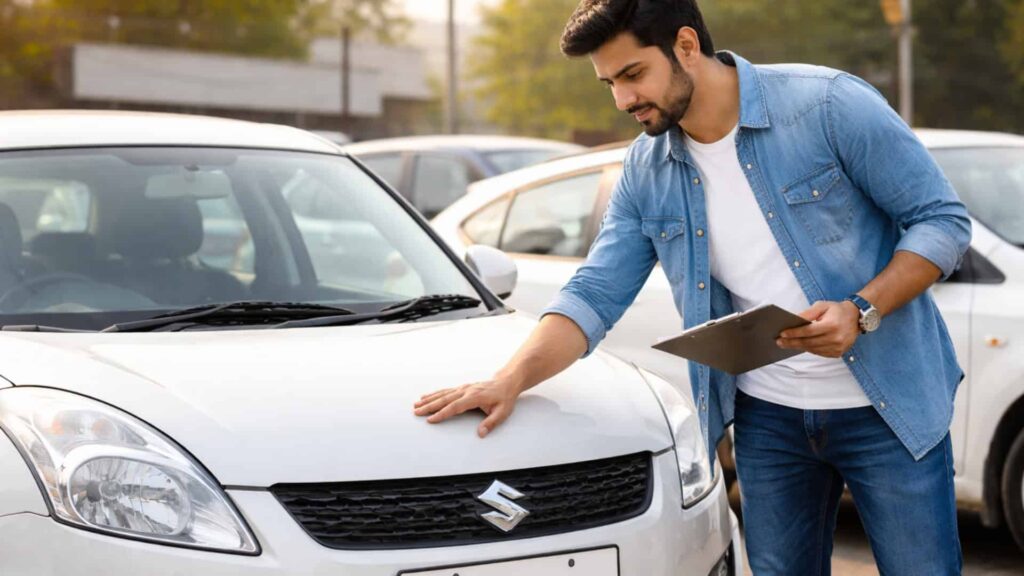
7. Inspect the Exterior (Through Photos and Videos)
If you are planning to buy a used car from an online portal, you should request the owner to send you high-resolution pictures and videos. These videos and pictures should be from multiple angles—front, rear, sides, under the bonnet, and wheel wells.
Once you will find the pictures of the car. You should inspect the following things.
- Look for the mismatched paint shades. If you can find that, it means the car has been painted or repaired again.
- Check the rust around the doors, bumpers, or wheel arches. If these areas are rusty, you should avoid these cars. Because they require replacement of parts or more maintenance.
- Check for the dents or cracks on the windshield and headlights.
If the seller hesitates to share detailed visuals, consider it a red flag.
8. Ask for a 360-Degree Virtual Inspection
Many top platforms now offer 360-degree car viewing. This lets you zoom into small details like panel gaps, tire wear, or scratches.
Combine this with an inspection report (if available) for a better understanding of the car’s condition.
9. Check Under the Hood-
When you go to buy an old car, you should ask the seller to open the hood and start the engine. Listen for irregular noises or smoke. A clean, well-maintained engine usually reflects proper care, while oily or dusty surfaces may indicate neglect or leakage.
Also, if you hear any kind of irregular noises from your engine, you should show up this car to the trusted mechanic. If he confirms that everything is fine, then only you should proceed to buy.
10. Examine the Tires
If you want to know, how has the car been driven before? Check its tires.
Tires can reveal driving habits. Uneven tread wear might indicate alignment or suspension problems.
If the tires are older than 5 years, replacement is due soon. Verify the tire manufacturing date printed on the sidewall (week/year format).
11. Analyze the Interior Condition
So we have checked the exterior and documentation so far, but don’t neglect the interior condition. A clean and well-kept interior reflects how the car has been treated overall.
The interior is something that gives you a vibe and confidence to drive it. Not only this, it also gives you comfort. So whenever you are seeing an old car, you should check the following things in the interior.
- First of all, you need to ensure that the seat fabric and covers are in good condition. They are not torn or strained.
- Now check the functionality of the air conditioning and infotainment system. These two things are very important to check. Because these systems are faulty, they are going to add up extra costs specially, when I talk about AC.
- Let’s check the dashboard cracks. Make sure there are no major cracks. Otherwise, you might have to replace it.
- If you are getting foul odors. It can suggest water damage.
12. Test the Electronics
Once you find it, check the interiors, and find nothing wrong with it. Next thing you need to do is check the electronics system of the car.
- Let’s pull the power windows up and down to check power button functionality.
- Make sure that the central locking is working perfectly fine.
- Check the reverse camera and sensors. They should be in working condition.
- Don’t forget to check the headlights, tail lights and indicators. Also, ensure that the glasses are not too dirty.
Small electrical issues can turn into costly repairs later.
13. Look for Accidental Damage
If you have not found anything wrong so far in the car. You should check for accidental damage. Many dealers paint the accidental cars just to make it look fine. This is specially done by the local dealers in Delhi NCR. So if you are buying a second-hand car from a dealer or seller, you must inspect the following things.
- Check for uneven gaps between panels.
- Repainted or replaced parts
- Rust or welding marks in the engine bay or boot area
- “Insurance claim” mentioned in the service report
Avoid cars with major structural damage; they often suffer long-term reliability issues.
14. Confirm Insurance Validity
When you are buying the car, you should ensure that it has active insurance. Also, check if it has a third-party or comprehensive. You can easily verify the insurance through the IRDAI website or the insurer’s app. This helps in ownership transfer and provides coverage if the car is test-driven or transported.
15. Check Loan or Hypothecation Details
If the car was financed, it might be under hypothecation. Ensure the loan has been fully repaid and the Form 35 (loan clearance certificate) is available. Hypothecated cars without clearance cannot be legally transferred.
16. Review Pollution Under Control (PUC) Certificate
In India, every car must have a valid PUC certificate. Make sure it’s up to date. You’ll need it for ownership transfer and re-registration. It also indicates how well the engine is maintained. If the car doesn’t have a PUC, you can go to the nearest PUC center and have one for the car.
17. Cross-Check VIN and Engine Numbers
Physically verify that the VIN (Chassis Number) and Engine Number match what’s mentioned in the RC and insurance papers. These are usually etched on the chassis plate and engine block.
18. Use RTO and Parivahan Online Verification
Visit Parivahan.gov.in → “Know Your Vehicle Details.” Enter the registration number to see:
- Owner details
- Registration date
- Engine capacity
- Fitness and insurance validity
This is the most official source to verify car authenticity online.
19. Check Service History with Authorized Workshops
Call or visit an authorized service center of the car brand (e.g., Maruti, Hyundai, Honda) and request the service history using the registration number or VIN. Genuine workshops maintain digital logs of every service, even if the car changed owners.
20. Research Common Issues for That Model
Before finalizing a used car, research that model’s common faults—for example:
- Hyundai i20: steering rattle in older versions
- Ford EcoSport: clutch wear after 40k km
- Maruti Swift: suspension noise after 60k km
This helps you negotiate better and anticipate maintenance costs.
21. Check the Ownership Transfer Process
Understand the process before buying:
- Obtain a Form 29 and Form 30 signed by both parties.
- Attach insurance, PUC, and ID proofs.
- Submit to the respective RTO or use Parivahan online transfer.
- Always receive a sale receipt and acknowledgement from RTO.
Never drive the car until the transfer is legally initiated.
22. Evaluate the Test Drive (If Possible)
Even when buying online, insist on a physical test drive or a third-party inspection. During the test:
- Check gear shifting smoothness.
- Listen for suspension and brake noises.
- Monitor steering alignment and acceleration response.
- Ensure AC and clutch performance are smooth.
23. Compare Prices on Multiple Platforms
Don’t finalize after seeing one ad. Compare the same model, year, and variant across platforms like CarTrade, ZigWheels, and Spinny. A big price difference might signal hidden issues or inaccurate odometer readings.
24. Get an Independent Mechanic’s Inspection
Hire a trusted local mechanic or a third-party inspection service like GoMechanic, Pitstop, or CarSure. They can perform on-site checks, including underbody, suspension, and diagnostic scans. Their unbiased report adds confidence to your decision.
25. Negotiate and Verify Payment Safely
Once satisfied:
- Negotiate politely based on inspection and market value.
- Use bank transfers or escrow services—never pay in cash without receipts.
- Collect a Delivery Note, Form 29/30, and sale receipt.
- Retain copies of all communication and documents.
Avoid advance payments before the car inspection or RC transfer.
Final Thoughts
Buying a used car online in India can save you money and time—but only if you perform due diligence. Follow these 25 expert tips to check the car’s authenticity, condition, and legal status before making any payment.
A well-researched second-hand car can serve you for years without problems, while a rushed decision can cost you more in repairs and paperwork hassles. Always prioritize verified sources, legal documentation, and professional inspections.
If you’re unsure, consult an automobile expert or a reputed inspection agency. Remember: in the world of used cars, information and verification are your best insurance.